Tuesday, April 23, 2013

Energy Flow Through Ecosystems #2

1. When light has low rates it then leads to low nutrients, it affect the amount of trophic levels in the ecosystem.

2. The amount of energy entering the ecosystem, energy loss between trophic levels, and the form, structure, and physiology of organisms at each level affect the ability of an ecosystem to support multiple trophic levels.

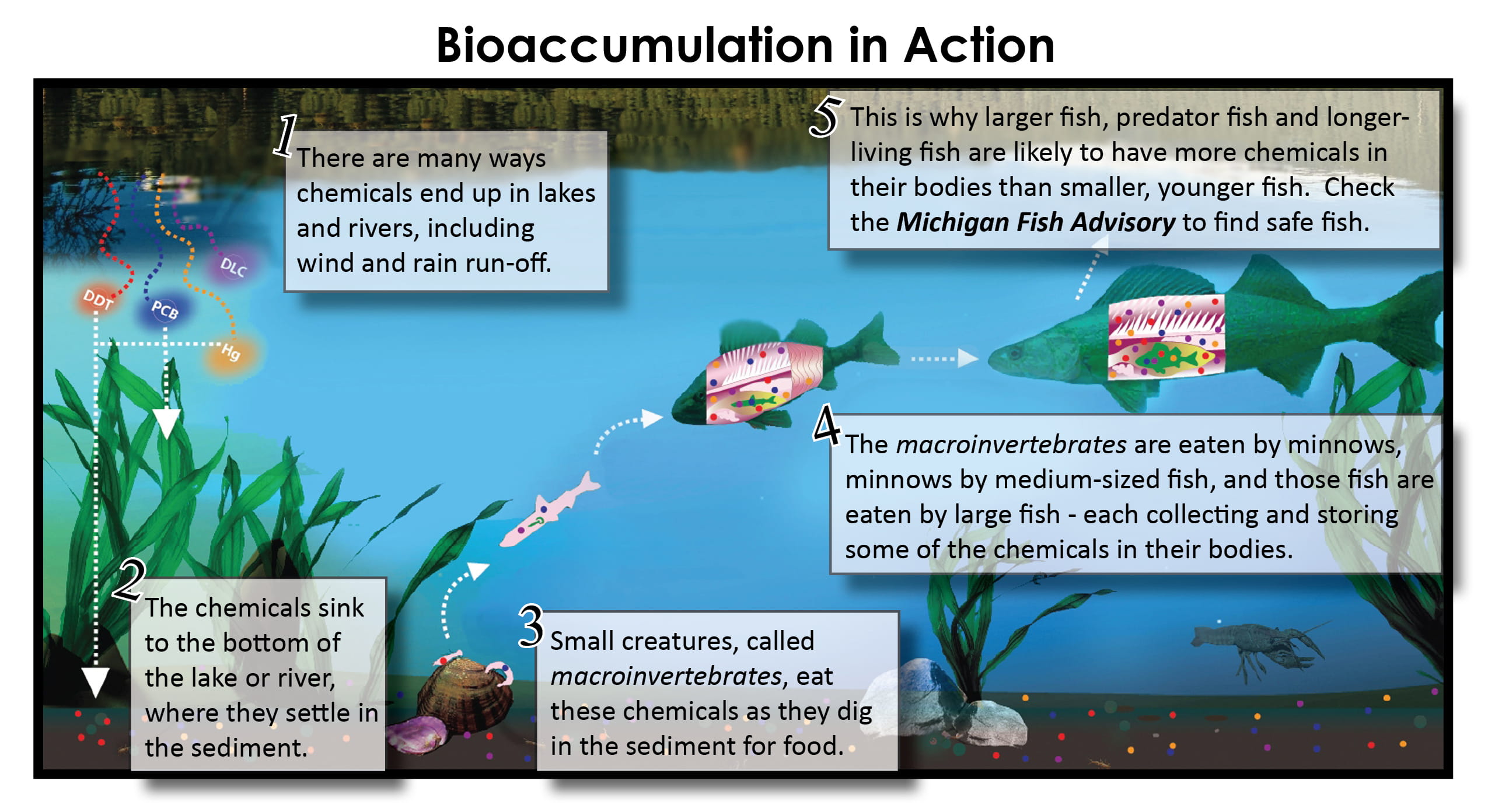
3. Bioaccumulation is an important consequence of the loss of energy between trophic levels is that contaminant's collect in animal tissues. An example of DDT is DDT build up in eagles and other raptors to levels high enough to affect their reproduction, causing the birds to lay thin-shelled eggs that broke in their nests.
SOURCE: http://www.michigan.gov/images/mdch/BIOACCUMULATION_IN_ACTION_354012_7.jpg

SOURCE: https://blogger.googleusercontent.com/img/b/R29vZ2xl/AVvXsEh2mfgFuJReakkbZ40m45BxrI0oKz17nH75NH4T4Ur-Jq_lCAYwH5UQHtIB8oYyFpoxNJQK32LVEhktTFpOsvw9qIwxiwSnGGin6C5CR2Naa_PIv_ioFvgixxV-8G4UBvy4EaqTJOvYv6Hv/s1600/DDT.jpg

Friday, April 19, 2013

Energy Flow Through Ecosystems

1. Some primary producers are organisms such as plants, algae, and some bacteria. They use photosynthesis to obtain energy.

2. The second trophic level is made up of herbivore animals that eat only plants, they get their energy from eating plants.

3. Predators are classified as the third trophic level because they feed at several trophic levels, if there are even larger predators they will make-up higher trophic levels.

SOURCE: http://goo.gl/5QeNS

SOURCE: http://goo.gl/wOq6q

Tuesday, April 16, 2013

Animal Habitat Structure

1. How does eelgrass density influence abundance of species in an ecosystem?
My hypothesis: The more dense the eelgrass, the more biodiverse the ecosystem because of the more availability for shelter and food.

Websites to support hypothesis:
                                                  1. http://goo.gl/IEgBK
                                                  2. http://goo.gl/X9o5w

SOURCE: http://www.afsc.noaa.gov/ABL/Habitat/images/Eelgrass_bed_sm.jpg

SOURCE: http://marinebio.org/i/biodiversity2.jpg

Thursday, April 11, 2013

Animal Habitats of San Diego Bay

1. San Diego Bay is home to a list of natural resources such as salt marsh and tidal flats, bird nesting and foraging sites, essential fish habitats such as eelgrass beds, and nine endangered species.

2. Invasive species are plants, animals, and microbes not native to a region which, when introduced, out-compete native species for available resources. Some were transported to SD Bay in ballast water of international ships, attached to boat hulls, sometimes they were introduced intentionally for fishing.

3. An endangered species is a species in danger of becoming extinct, not existing. Green turtles are an endangered species of SD Bay, and the marine turtle research program attempt to raise funds for the conservation of sea turtles.

SOURCE: http://goo.gl/BiMdX


SOURCE: http://goo.gl/NStfU

Wednesday, April 10, 2013

Introduction to the San Diego Bay

1. The San Diego Bay is located in San Diego county, has 34 miles of scenic waterfronts with restaurants, shops, and attractions.

2. In the bay, you can go on cruises, visit shops and go to museums.

3. The South San Diego Bay restoration and enhancement project dredges former salt ponds to create tidal channels and tidal influence.

4. The San Diego National Wildlife Refuge Complex is located in Seal Beach, Tijuana Slough, and Sweetwater Marsh.

5. The purpose of the San Diego National Wildlife is that they support habitats as diverse as coastal marshes and uplands, oak woodlands, freshwater marshes, and resident bird species in south San Diego Bay.

SOURCE: http://goo.gl/D8Xta
SOURCE: http://goo.gl/HxVaV

Thursday, March 28, 2013

Ocean Water & Climate Change

1. Which is more dense: ocean water or fresh water, & why?
Ocean water is more dense that fresh water. Ocean water is more dense because of the salt in it. and the temperature, it gets more dense as temperature goes down.

2. How would global warming change water at the poles and the equator?
Warmer temperature could increase the amount of water vapor that enters the atmosphere. The result is a hotter, more humid environment. At the equator, changes are not expected to be large.
SOURCE: http://www.oceanographers.ru/podcast/wp-content/uploads/2008/11/antarctic_bottom_water_hg.png
SOURCE: http://www.nasa.gov/images/content/219452main_PIA10362-516.jpg

Monday, March 25, 2013

Surface Water & Global Temperatures

1. Thermal Inertia: San Francisco and Norfolk, Virginia are on the same latitude why would Norfold, compared to SF, have warmer summers and cooler winters?
The air in San Francisco has moved over the ocean, while air in Norfolk has approached over land. Water doesn't warm as much as land in the summer, nor cool as much in winter.

2. Describe the different ways temperatures are "moderated" on Earth. Without moderate temperatures, Earth could not support life as we know it.
Water vapor absorbs heat and releases it slowly. At night when the humidity is high, the atmosphere retains heat, and nighttime temperatures stay somewhat high. On dry nights, with little water vapor to absorb heat, the atmosphere cools off rapidly.
SOURCE: http://www.ucar.edu/learn/images/radiate.gif

SOURCE: http://www.edfenergy.com/energyfuture/images/schematic/greenhouse-effect.jpg